(Photo: Courtesy Trust for Public Land)
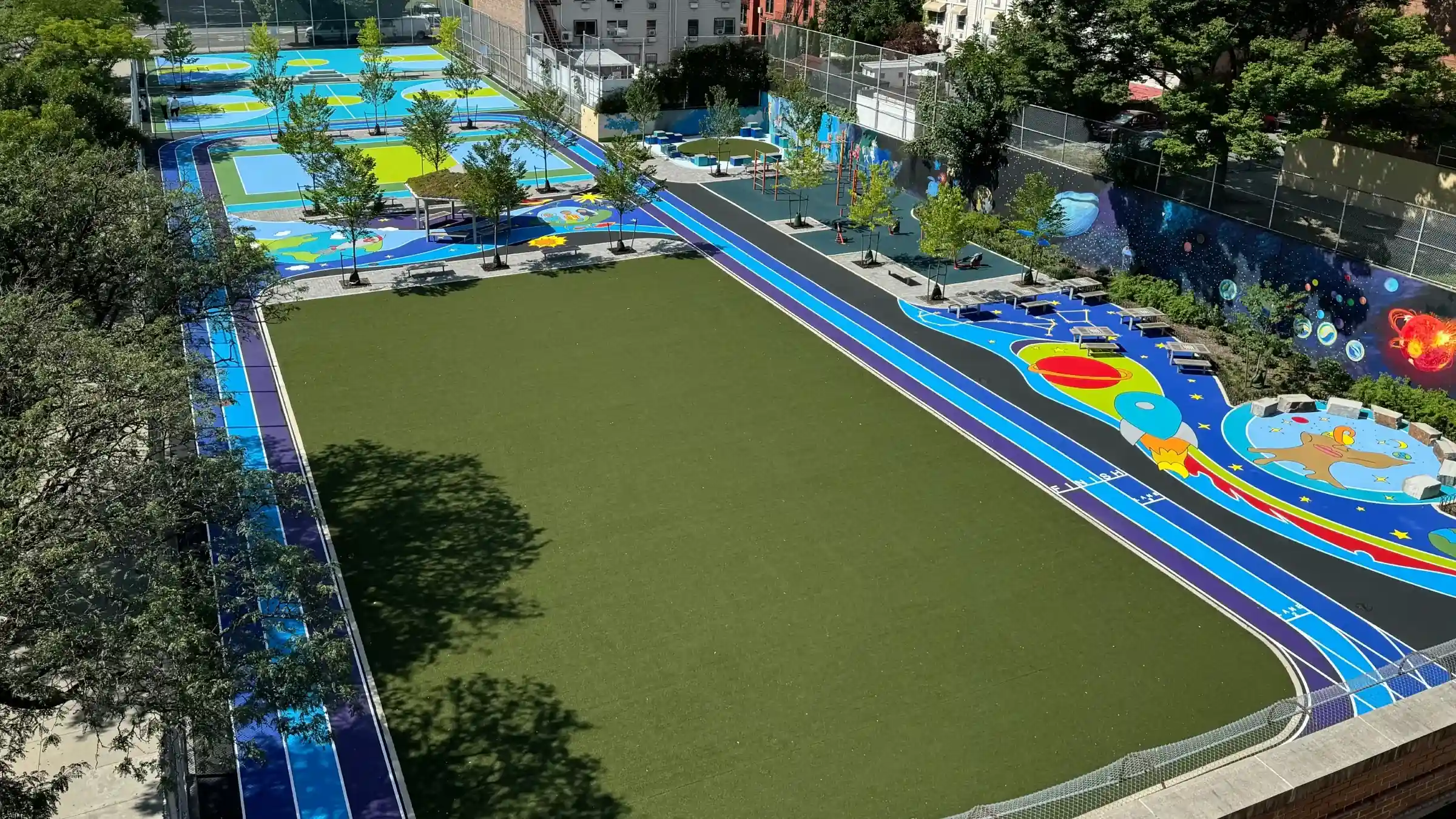
Three decades ago, the outdoors-focused nonprofitTrust for Public Land(TPL) was working with a community in Newark, New Jersey, to establish a space for children to play. While the neighborhood didn’t have much available space to turn into a traditional park, there was a school close by. Residents asked TPL whether the schoolyard could be given a natural makeover and then opened to the entire neighborhood outside of regular school hours. “As with all truly great ideas,” says Danielle Denk, the national Schoolyards director, “this one came directly from the community.”
Since then, TPL has transformed 350 schoolyards across the United States into more natural, community-driven green spaces. As climate change looms and temperatures rise, surfaces made of concrete, asphalt, or compacted ground can heat to over 160 degrees Fahrenheit in the sun and don’t allow the earth to naturally absorb rainwater. When TPL replaces those manmade surfaces with gardens, trees, and other natural landscapes, not only do the schoolyards transform into small parks for the entire surrounding community, but they can also positively impact the natural flow of water. The result is healthier rivers and creeks and help with severe flood damage prevention.
Sometimes, the students of the schools help with the design. After learning about stormwater runoff at a field trip to a wastewater treatment plant, fourth graders at the E.M. Stanton School in Philadelphia, Pennsylvania, voted to install a rain garden in their schoolyard rather than expand their playground.
“That moment showed us something important: when students understand the challenges their communities face, they are ready to help solve them,” says Denk. “These interactions are not only about design, but they empower students to be climate problem solvers—a skill that they will need long into the future.”
With almost 100,000 public schools in the U.S. and 2 million acres of potential outdoor space, TPL has big dreams of improving more. “More than 100 million Americans—including 28 million kids—don’t have a park within a ten-minute walk,” says Denk. “Schoolyards are the solution hiding in plain sight to close that gap.”
TPL is scaling its work with Tribal Nations via the Tribal Schoolyard Program, which has been around for three years. Through this branch of the program, traditional playgrounds and blacktops are transformed into living schoolyards, and there is an additional focus on cultural elements, like history, language, and intergenerational learning.
In 2026, TPL partnered up with the National Fund and theBureau of Indian Educationto reimagine the school grounds of Havasupai Elementary School. The school, which sits at the bottom of the Grand Canyon, will receive new swings, rock climbing walls, and a community mural that reflects the tribe’s spiritual and ancestral connection to the area.
“After 30 years of success with our urban Community Schoolyard model, we saw an incredible opportunity to partner with Indigenous communities to create outdoor spaces that are as rich and diverse as the cultures they represent,” says Jen Santry, TPL’s Tribal Schoolyards director. “We realized that for students in Indian Country, the schoolyard could be a vital bridge between the classroom and the traditional lifeways of the community and heritage.”
Community, not only kids, is a main focus of TPL’s Schoolyard initiative. The new mini parks are places for groups to organize events, neighbors to meet, and everyone to enjoy nature. “When schoolyards are designed with both the school and the surrounding community, something powerful happens. The design process itself often becomes a catalyst for connection,” says Denk. “Once people start working together to imagine a shared space, relationships begin to form.”
This article is from the Summer 2026 issue of Outside magazine. To receive the print magazine,become an Outside+ member here.